The handoff is part of the work
NVIDIA's October 21 Microduck tutorial describes a route from training in Isaac Lab with Newton to evaluating a policy, exporting it to ONNX, and deploying it on configured physical hardware. It identifies actuator behavior and domain randomization as parts of preparing for the move out of simulation.
That is a workflow, not a guarantee that any successful simulated motion will work on any robot. The tutorial names hardware and software prerequisites, and it emphasizes keeping the policy's observations and actions consistent through deployment. Those details are central to understanding the demonstration.
Our reading is that the useful story lies in the handoff. A robot policy does not travel alone: it travels with assumptions about what its inputs mean, how its outputs are interpreted, and what the surrounding machine can do. If those assumptions are lost, an exported file can be technically valid while the resulting behavior is wrong.
Signal Scroll has not trained or deployed this policy. This is a methods explainer about planning transfer checks, using the tutorial as a current example. The paper exercises below require no robot and make no claims about measured Microduck performance. Physical deployment should follow the project's current instructions and an appropriately supervised, bounded setup.
Source: NVIDIA: Train in Simulation, Deploy on a Real Robot—Microduck with Isaac Lab 3.0 ↗ · Isaac Lab: Microduck task configuration linked by the tutorial ↗
Name the worlds you are comparing
Begin with a simple separation. The simulated world has a description of the robot and environment. The software running the policy sees a particular representation of that world. The physical system produces measurements and responds through real hardware. These are connected, but they are not interchangeable.
For a proposed planning document, make three columns: intended condition, simulated representation, and physical observation. A condition might be standing on a level surface. The simulated representation is whatever the task configuration actually implements. The physical observation is what you would need to check on the real setup, rather than assume from its appearance.
Now identify one possible mismatch in each row. A surface that looks flat may behave differently under contact. A command that arrives in order during a desktop test may arrive with a delay in another setup. These are hypothetical examples to guide inspection, not reported faults in Microduck.
The purpose is to make the comparison operational. Writing real world differs from simulation is true but too broad to guide a test. Writing we have not checked whether this input uses the same coordinate convention gives the team a specific question to resolve before permitting motion.
Read the task configuration linked from the tutorial before treating the policy as a portable black box. The official source is a place to inspect the declared task, rather than rely on a diagram or a remembered command. Save the revision you inspect because a repository's main branch can change.
For your own hypothetical controller, write an interface contract in ordinary language. It should name every input, its units, order, expected range, and timing. It should also name every output and the component that interprets it. Mark any field you do not understand as unresolved.
Imagine two inputs called angle, one expressed in degrees and the other in radians. A file conversion might succeed while this semantic mismatch remains. Or imagine a list whose values are all individually plausible but whose ordering has changed. A shape check alone would not reveal the meaning changed.
These examples are ours, not a diagnosis of the released stack. They illustrate why transfer validation should include the meaning of data as well as its format. You would not read a laboratory measurement without knowing its units; a policy input deserves the same care. The contract is the place where those meanings become reviewable.
Make one uncertainty large enough to see
Domain randomization can sound like a promise that a policy has practiced for every surprise. The tutorial uses it as one component of preparation, alongside modeling actuator response. Our interpretation is narrower: variation in training should lead you to ask which variations were included and which remain outside the exercise.
For a paper experiment, choose one hypothetical uncertainty, such as a delay between an action and its effect. Describe three conditions: the expected delay, a moderately longer delay, and a delay beyond what the team intends to support. Do not invent numerical settings for a real robot; use placeholders until the hardware documentation and test plan justify values.
Write what you would observe in each condition and when the experiment would stop. A useful record includes whether the system completed the task, how it deviated, and what the surrounding safeguards did. It should not reduce every run to a cinematic success or failure.
You are learning how to make an uncertainty testable. Randomly changing many things at once might make an impressive stress video, but it can make the result hard to interpret. Start with a question specific enough that another person can tell what changed and what the observation means.
A simulation-only activity for a reading group
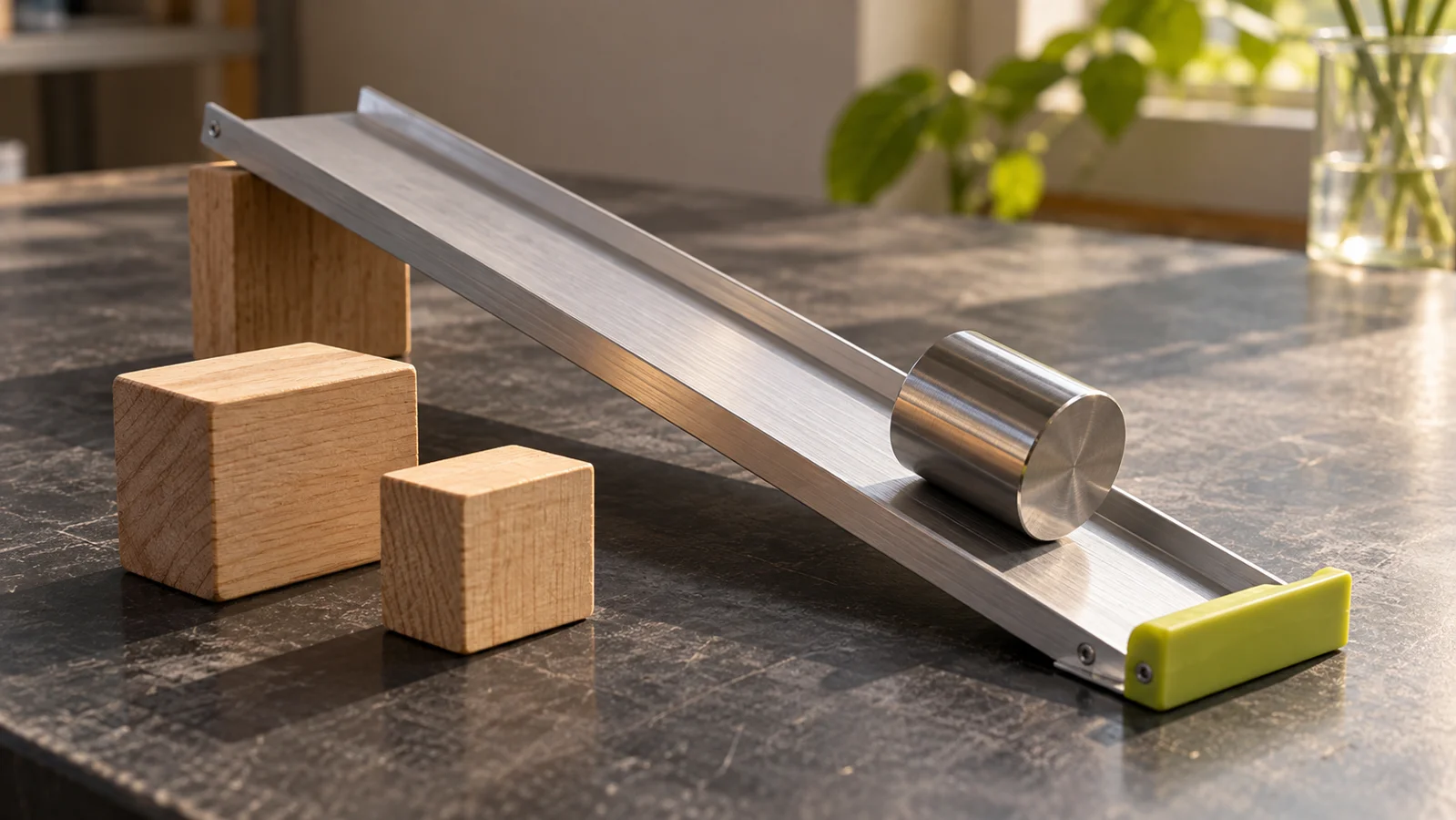
You can practice transfer thinking with a drawing. Sketch a simple virtual cart moving along a line toward a target. Define an observation as its reported distance from the target, and define an action as a requested movement. No motor, robot, or executable policy is required.
On the first page, assume the reported distance is exact and the movement happens immediately. On a second page, imagine that the observation arrives one step late. On a third, imagine the action moves the cart by a different amount than requested. Ask whether the same simple rule would still reach the target and where it might overshoot.
Keep the model deliberately elementary. You are not simulating Microduck, validating a control algorithm, or proving a safety result. You are building intuition for why a policy can depend on the conditions under which it receives information and acts.
Have each participant write one assumption they initially forgot. Then compare the lists. One person may notice timing; another may notice units; another may notice the target changes. The activity becomes useful when it expands the team's vocabulary for uncertainty before anyone is tempted to solve uncertainty with another training run.
An exported model file is an artifact. A running physical system is an arrangement of artifacts, configuration, sensors, actuators, and people responsible for the experiment. A useful plan gives those different things separate checks.
First, propose an artifact check: record the model's identity, origin, revision, and expected interface. Second, propose a software check: verify the runtime receives and produces the documented values in the documented order. Third, propose a behavior check: define a bounded task and the evidence that would show it was completed under the intended conditions.
Passing the first check should not silently count as passing the third. Imagine a project presentation where someone says deployment worked because the file loaded. A reviewer should ask whether that means the runtime accepted the file, a replay produced expected outputs, or the physical system performed a defined task.
This is not pedantry. Each statement supports a different next step. A successful file load might justify continuing software integration. A carefully recorded behavior test might justify expanding the test envelope. Neither automatically justifies leaving a machine unattended or extending the result to other hardware. Keep the language proportional to the evidence you actually collected.
Keep changes small enough to explain
Suppose a team changes its simulator version, control configuration, and physical surface between two demonstrations. If the second behaves differently, the team has several possible explanations. A proposed transfer notebook should make that visible rather than summarize the difference as a better policy.
For each session, record what stayed fixed and what changed. Include software revision, configuration, model artifact, and the environment description appropriate to the task. Note deviations from the intended procedure at the time they happen. A later reconstruction from memory is less useful for explaining an unexpected run.
Try changing one condition in the written plan before proposing a larger experiment. If the team cannot explain the expected effect of that one change, the next step may be inspection rather than action. A good question can save more effort than a long sequence of poorly understood trials.
Also keep a known reference case. That lets the team ask whether a new observation is specific to the changed condition or reflects a broader setup problem. This is our suggested experimental habit, not a claim that a single reference run proves reliability. Its value is making the interpretation of each new observation less ambiguous.
A demonstration needs a caption that states its limits
When you watch a robot clip, look for the missing caption. Which environment was used? Was the policy fixed throughout? How many attempts preceded the shown run? Was there outside intervention? What counted as success? The clip may be honest and useful while leaving those questions unanswered.
For your own work, draft the caption before the experiment. A hypothetical caption might say that a simulation-only test completed a defined path under one configuration, with other conditions not evaluated. That is less dramatic than a broad claim about autonomy, but it tells another builder what evidence exists.
Do not infer a test count, a success rate, or robustness from a highlight reel. Likewise, do not accuse a project of failure merely because a short tutorial omits a measurement outside its purpose. Distinguish not reported from reported and poor. Each calls for a different response.
A useful reading-group exercise is to write two versions of a caption for the same imagined result: one that overclaims and one that is accurate. Then underline exactly what evidence would be needed to justify the extra words in the first. This turns media literacy into a concrete part of technical learning.
Imagine that an observation replay looks correct but a bounded physical trial differs from expectations. Your proposed investigation should first ask which assumption the mismatch challenges. Is the observation stale? Is the action interpreted differently? Is the environment outside the intended range? Is the behavior objective itself poorly specified?
Those are diagnostic questions, not instructions to adjust a real controller blindly. A physical system deserves a test plan that respects its documented limits and the competence of the people supervising it. Software confidence does not substitute for understanding the machine.
For a simulation-only project, you can still practice the same reasoning. Add a hypothetical timing mismatch to the written interface, predict how it could affect the result, and specify what evidence would distinguish it from an ordering error. If two explanations predict the same observation, design another observation that separates them.
This is where simulation becomes more than a place to produce a convincing clip. It becomes a place to ask which mechanisms might matter and which measurements would help you tell them apart. The reward is an experiment you can explain, including what its result would leave unresolved.
What a useful transfer plan contains
By the end of a first planning session, aim for four small artifacts. Write a clear task statement, an interface contract, a list of uncertain assumptions, and a staged verification plan. Keep each short enough that another person will actually read it.
The task statement identifies the behavior you care about. The contract identifies what the policy receives and emits. The uncertainty list identifies where simulation and deployment might diverge. The verification plan identifies what must be checked before the next stage is justified.
Assign an owner to each unresolved question in a group project. Someone needs to inspect the current documentation, someone needs to confirm the meaning of a field, and someone needs to decide whether the proposed experiment fits the available environment. Responsibility should be as explicit as the model filename.
NVIDIA's tutorial provides a concrete current example of a learning-to-deployment route. The transferable skill is seeing the assumptions carried along that route. A successful simulation can be an excellent starting point. Turning it into credible evidence for a physical task requires preserving meaning, recording conditions, and knowing precisely what the next test is supposed to establish.
Try this, then make it yours.
On paper, define a simple cart controller, then change observation timing and action scale separately and describe what evidence would reveal each mismatch.
Explore the tool ↗Follow the signal.
Our reporting starts here. Practical suggestions are our analysis, and vendor performance statements are claims unless independently verified. We haven’t hands-on tested this release.
- NVIDIA: Train in Simulation, Deploy on a Real Robot—Microduck with Isaac Lab 3.0 ↗ · 2026-10-21
- Isaac Lab: Microduck task configuration linked by the tutorial ↗