The room has more than one version
A video of a room can be visually convincing while leaving important questions unanswered. What is behind the cabinet? Which objects were visible in the input? Does the scene remember what changed after something moved out of view?
The October 23 Mundo research walkthrough describes a system that builds a simplified 3D proxy from views of a place, maintains scene state through code and simulation, and uses a video model to render the result. The project demonstrates exploration, edits, and interactions. This is research reporting, not a hands-on review or a claim that a consumer app is ready to reconstruct every room.
The authors identify limits including slow reconstruction and rendering, problems with small-object interactions, and the absence of long-horizon memory. They also note that areas outside the input views must be inferred. Those limitations matter because visual polish can make an inferred detail feel observed.
Our interpretation is that the most useful way to watch a world-model demo is to track three versions of the room: the observed evidence, the internal scene description, and the generated appearance. They are related, but they answer different questions.
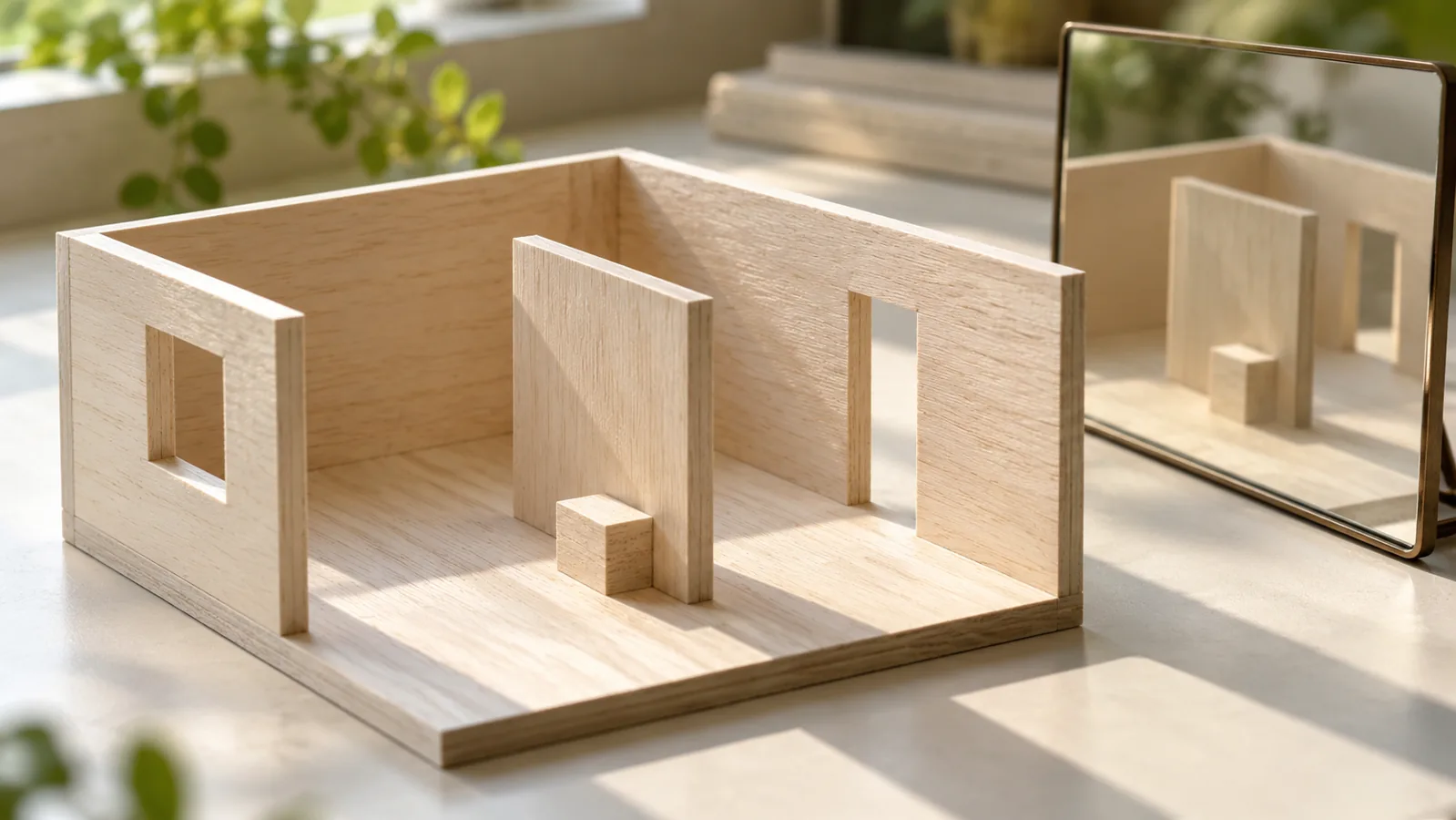
Imagine a hypothetical creator planning a short clip in a simple room with a box beside a partition. They want to explore a camera move and a change in object position. This article develops a reading and planning exercise around that scene. We have not run Mundo or reproduced its results. The exercise is designed to help you describe what a demo establishes before treating its generated room as a reliable model of reality.
Source: Mundo authors: From seeing a place to simulating what happens there ↗ · Mundo: Customized World Model project and pipeline ↗
An internal scene is a useful simplification
Mundo's project page separates building the proxy, running the world as code, and rendering video. Its proxy represents objects and placement; the code tracks states and interactions, while the video model supplies appearance using context views. This separation is the technical idea worth understanding before judging the final clip.
A simplified representation can make a question easier to compute. For our hypothetical room, you might represent a cabinet as a box and a partition as a plane. That could be enough to reason about a broad camera path. It would not necessarily describe the exact shape of a handle or a narrow opening.
The important question is whether the simplification preserves what your task depends on. If the clip only needs a camera to move around a large stationary object, broad geometry may be useful. If the scene depends on a small object fitting through a precise gap, the missing detail becomes central.
Write the required relationships in plain language before choosing a tool. The box stays on the same side of the partition. The camera passes through the doorway rather than the wall. The cabinet remains in the same place when it returns to view. These are proposed checks for the example, not assertions about Mundo's behavior on a test we performed.
This framing also helps creative work. You can decide which relationships must remain stable and which details may be stylized. A deliberately dreamlike clip may allow transformations that an instructional reconstruction cannot. The quality standard follows the purpose.
A useful model is therefore not the one with the most detail in every frame. It is one whose representation supports the particular decisions you need to make, with the remaining uncertainty made visible.
Keep a list of what the camera never supplied
For the proposed exercise, draw a simple floor plan and mark where the input views were taken. Then list the surfaces or spaces no view shows. You can do this with your own harmless tabletop model or a public research example; there is no need to upload a private room.
This list changes how you interpret generated views. If a later frame reveals a shelf that was never visible, treat the detail as inferred unless other evidence establishes it. It may be useful creative completion, but it should not be described as a recovered fact.
Now ask how important that hidden detail is. A background texture may be acceptable to invent for a fictional clip. The location of an exit is a different kind of claim. Do not transfer confidence from the first use to the second simply because the image looks equally convincing.
You can make the exercise more concrete with two drawings of the same unseen corner. Both should fit the visible input but differ in a detail behind the partition. If both are plausible from the evidence, the input does not uniquely determine that detail. This is a reasoning demonstration, not a measurement of the model.
The same habit helps when watching demos on social media. Ask which input views were supplied and whether the output perspective reveals anything genuinely constrained by them. If the evidence is not shown, keep the conclusion narrow.
More views can supply more information, but count alone is not the full story. For your own planning, choose views that reveal a missing relationship rather than collecting many nearly identical angles. The purpose is to reduce a specific uncertainty. A good capture plan explains what each additional view would help establish.
Separate a physical event from its cinematic appearance
A scene can have an orderly internal state and still produce a visually awkward interaction. Conversely, a fluid-looking clip can conceal a spatial inconsistency. Our proposed review therefore uses two passes: one for relationships and one for appearance.
In the relationship pass, ignore surface polish. Track where the hypothetical box starts, where it moves, and what it is allowed to intersect. Note any moment when an object disappears behind the partition and returns. Ask whether the described state is still consistent.
In the appearance pass, inspect texture, lighting, and how the motion is presented. Does the box look like the same object? Does the surface remain coherent? Does the camera movement support the intended story? These questions matter for a creative deliverable, but they do not replace the relationship checks.
Mundo's architecture makes the distinction especially visible because the proxy video guides a separate appearance-generation stage. The project page describes flat-category proxy frames as part of that pipeline. That does not mean every final visual detail is a direct measurement of the simulated state.
For the exercise, write a hypothetical failure that each pass could catch. A box could remain on the correct side of the partition but change appearance. Or it could look consistent while moving through a wall. Keeping the failures separate makes your feedback more useful than saying the clip feels wrong.
When giving an AI tool a revision request, identify the violated relationship or visual issue precisely. Do not ask it to make everything realistic and assume all problems will be solved together. A focused request gives you a clearer criterion for checking the next output.
The result is a creative review process that respects both storytelling and structure. You can enjoy the look of a scene while still asking whether it obeys the relationships your project requires.
Use a small continuity test instead of a spectacular stunt
The most informative proposed first test is ordinary. Move the camera so the box becomes occluded, then reveal it again without changing its intended state. This asks a limited question: is the scene consistent across a temporary loss of visibility?
Record what must remain stable. For the hypothetical room, that could be the box's position, size, orientation, and relation to the partition. Decide these criteria before looking at the output. Otherwise a striking frame may persuade you to overlook a change you would have considered important beforehand.
Next introduce one deliberate change. Move the box to a new position while keeping the camera plan the same. Compare the intended change with anything else that moved. You are trying to distinguish controlled editing from uncontrolled scene drift.
This is not a claim that Mundo will pass or fail the proposed test. It is a method for making a world-model demonstration more interpretable. The authors' stated memory limitations are a reason to ask continuity questions, not grounds for inventing a result.
Keep the time horizon in the report. A short successful reveal is evidence about that short sequence. It does not establish persistent memory across a long interactive session. If you extend the test, record the extension as a new condition.
A tabletop paper version can teach the same reasoning. Photograph or sketch a simple arrangement, hide one view, and ask another person what can be inferred. Compare their reconstruction with the actual arrangement. You learn which parts of the scene were underdetermined without needing specialized compute.
For creators, this kind of quiet test can be more useful than immediately requesting an elaborate action sequence. It isolates a relationship you can inspect, gives you a meaningful failure description, and helps decide whether the tool fits the next stage of your project.
Choose the right claim for the final clip
Before sharing an AI-generated room, decide how you will describe it. Conceptual visualization, reconstructed scene, simulated interaction, and measured physical prediction are different claims. The same attractive video should not acquire a stronger label merely because it appears in a professional presentation.
For our hypothetical creator, a fair caption might explain that the clip explores a possible camera move using an inferred scene. If some details are invented, say so. If the clip is based on input images, identify that relationship without implying every hidden surface was observed.
Also choose input material appropriately. Use a scene you own or have permission to process, and keep personal documents, recognizable people, and private details out of casual experiments. This is a practical boundary for the exercise, not an assertion about how Mundo stores or handles data.
Do not interpret a robotics demonstration as permission to use a generated reconstruction for a real-world safety decision. That stronger use would require suitable validation and expertise beyond a visual review. This article focuses on understanding research and planning creative work.
The useful next step after a demo is a question you can answer. Perhaps you need to know whether a camera path preserves geometry, whether an edit stays localized, or whether an occluded object returns consistently. Choose one and record what evidence would satisfy it.
Mundo's research is interesting because it connects an explicit scene, simulated state, and generated appearance. The durable skill is keeping those layers distinct while judging the result. A convincing room becomes more useful when you know which details came from observation, which came from a model, and which claims still need a check outside the video.
Try this, then make it yours.
Sketch a room with one box and a partition. Mark the unseen area, choose a short camera path, and define three properties that should remain stable when the box is hidden and revealed. Use that checklist while reading a public demo.
Explore the tool ↗Follow the signal.
Our reporting starts here. Practical suggestions are our analysis, and vendor performance statements are claims unless independently verified. We haven’t hands-on tested this release.
- Mundo authors: From seeing a place to simulating what happens there ↗ · 2026-10-23
- Mundo: Customized World Model project and pipeline ↗